Environment JDM configs
It is possible to create environments and environment specific JDM configurations.
If JDM has environment specific configurations then JDM gets executed with each environment configuration in parallel.
Environment specific configuration overrides JDM's configuration, so it is possible to save common configs in JDM configuration and
only specific configs in the environment configuration.
There is no UI for the environments currently so they can only be created directly in database.
Create environment
table environment
idautoincrementnamerequireddescriptionoptional
example:
Create JDM environment config
table job_dispatcher_mapping_config
idautoincrementjob_dispacther_mapping_idforeign key to job_dispacther_mappingenvironment_idforeign key to environmentconfigjson configuration
example:
INSERT INTO job_dispatcher_mapping_config (`job_dispatcher_mapping_id`, `environment_id`, `config`)
VALUES (1, 1, '{"shopwareApi":{"host": "http://localhost","accessKeyId":"test","secretAccessKey":"test"}}');
Execute flow with JDM environment configs
If JDM has the following environment configs:
+----+---------------------------+----------------+------------------------------------------------------------------------------------------------+
| id | job_dispatcher_mapping_id | environment_id | config                                                                                         |
+----+---------------------------+----------------+------------------------------------------------------------------------------------------------+
| 78 |                         1 |              1 | {"shopwareApi":{"host": "http://dev.localhost","accessKeyId":"test","secretAccessKey":"test"}} |
| 79 |                         1 |              2 | {"shopwareApi":{"host": "http://stg.localhost","accessKeyId":"test","secretAccessKey":"test"}} |
+----+---------------------------+----------------+------------------------------------------------------------------------------------------------+
then the flow execution looks like this:
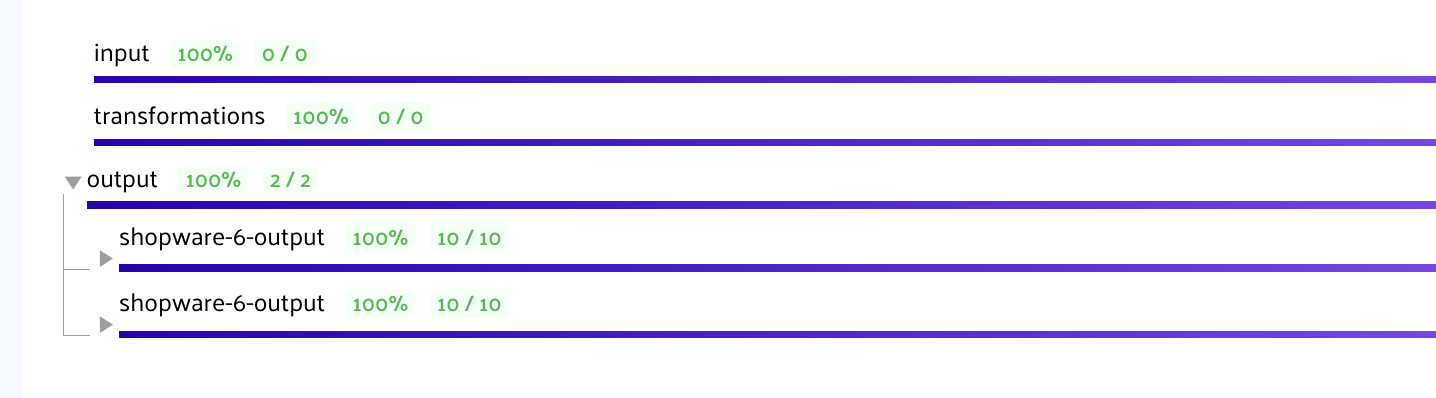
First shopware-output-6 was executed with the config of environment 1
Second shopware-output-6 was executed with the config of environment 2
Extending the environment-specific configuration
The environment-specific configuration inherits all keys from the JDM configuration. It's possible to extend the JDM configuration with additional keys in the environment-specific configuration. Configuration keys can be overridden. The environment-specific configuration has the highest priority.
Example: The main JDM configuration is a common Shopware 6 configuration:
{
  "system": {
    "key": "synqup"
  },
  "_filter": {
    "query": "{\"tags\": {\"$nin\": [\"ignore_global\"]}}"
  },
  "locales": {
    "de-DE": [
      "DE"
    ],
    "en-GB": [
      "EN"
    ]
  },
  "lastSync": "@0",
  "_lastSync": "2000-01-02T00:00:00.000Z",
  "batchSizes": {
    "cache": 100,
    "delete": 150,
    "upsert": 25,
    "batchSize_": 50,
    "deltaCount": 425
  },
  "identifier": {
    "customFieldName": "synqup_identifier",
    "customFieldSetName": "synqup_identifier_set"
  },
  "shopwareApi": {
    "host": "https://localhost:8001",
    "accessKeyId": "***",
    "secretAccessKey": "*****"
  },
  "subsections": {
    "tax": {
      "enabled": true,
      "batchSizes": {
        "cache": 70,
        "upsert": 30,
        "deltaCount": 100
      },
      "associations": {
        "taxRules": {
          "associationsMappingMode": "ignore"
        }
      }
    },
    "product": {
      "_filter": {
        "query": "{\"identifier\": {\"$regex\": \"_ex_custom_gross\"}}"
      },
      "enabled": true,
      "__filter": {
        "query": "{\"identifier\": {\"$in\": [\"_valEx_product_cross_selling_assigned_products_invalid\", \"_valEx_cross_selling_invalid_product\"]}}",
        "operator": "and"
      },
      "variants": {
        "enabled": true,
        "storefrontSettings": {
          "media": {
            "enabled": true,
            "filenames": {
              "prefix": null,
              "forbiddenCharacters": null,
              "keepOriginalFilenames": true,
              "characterReplacementMap": [],
              "defaultReplacementCharacter": null
            },
            "mediaFolderId": "019081e026c67ad28b6f289331b22eec",
            "uploadPriority": 0,
            "assetGroupTypes": [
              "CONFIGURATOR_SETTING"
            ]
          },
          "upsertStorefrontSettings": true
        }
      },
      "___filter": {
        "query": "{\"identifier\": {\"$eq\": \"_ex_suffix_price_list_example\"}}"
      },
      "deleteMode": "hard",
      "warehouses": [
        "1"
      ],
      "_batchSizes": {
        "cache": 100,
        "upsert": 50
      },
      "associations": {
        "tags": {
          "associationsMappingMode": "delta"
        },
        "categories": {
          "preMapBulkSearch": true,
          "associationsMappingMode": "delta"
        },
        "properties": {
          "preMapBulkSearch": true,
          "associationsMappingMode": "delta"
        },
        "visibilities": {
          "associationsMappingMode": "delta"
        }
      },
      "priceRounding": {
        "precision": null
      },
      "productNumberField": "identifier",
      "mapCanonicalProducts": true,
      "enableDeliveryTimeHandling": true,
      "defaultTierPriceShopwareRuleId": "018b386e03817068a76281b663a1176d",
      "deleteAnomalyThresholdPercentage": 10
    },
    "_country": {
      "enabled": true
    },
    "category": {
      "enabled": true,
      "deleteMode": "hard",
      "defaultShopwareLayout": {
        "autoDetection": true,
        "defaultLayoutShopwareId": null,
        "overwriteShopwareLayoutId": false
      },
      "rootCategoryShopwareId": null,
      "category-operations-anomaly-check": false
    },
    "propertyGroup": {
      "enabled": true,
      "deleteMode": "hard"
    },
    "extractEmbedded": {
      "enabled": true,
      "batchSize": 500,
      "extractProductInfo": true,
      "extractCustomerInfo": false
    },
    "propertyGroupOption": {
      "_filter": {
        "query": "{\"identifier\": {\"$in\": [\"83b61dc53829dbe51a390e4087876b67\", \"500d08c2a22017dc7cd66a3663afe8fa\"]}}",
        "operator": "and"
      },
      "enabled": true,
      "batchSizes": {
        "cache": 1000,
        "delete": 100,
        "upsert": 250,
        "validate": 500
      },
      "deleteMode": "hard"
    }
  },
  "customFields": {
    "fill": {
      "sets": [],
      "fields": [],
      "whitelistMode": false
    },
    "create": {
      "sets": [],
      "fields": [],
      "whitelistMode": false
    },
    "ignore": {
      "sets": [],
      "fields": [],
      "whitelistMode": false
    },
    "enabled": true,
    "autoCreate": true,
    "customFieldTypeMap": {
      "some-custom-field-name": "bool_checkbox"
    },
    "validateAttributes": true,
    "passThroughUnknownTypeValues": false
  },
  "sanityChecks": {
    "channels": {
      "ignore": [
        "_ex_invalid_channel",
        "Kaut-Bullinger"
      ]
    }
  }
}
Then you can create an environment-specific configuration for a certain shopware instance by overring the shopwareApi
host. Additionally, you can set a filter to the products' identifiers:
{
  "shopwareApi": {
    "host": "https://shopware-instance-1.com"
  },
  "subsections": {
    "product": {
      "_filter": {
        "query": "{\"identifier\": {\"$regex\": \"_ex_custom_gross\"}}"
      }
    }
  }
}
Another environment-specific configuration for another shopware instance:
{
  "shopwareApi": {
    "host": "https://shopware-instance-2.com"
  },
  "subsections": {
    "product": {
      "_filter": {
        "query": "{\"identifier\": {\"$regex\": \"_ex_custom_net\"}}"
      }
    }
  }
}
Environments and Config Snippets
It is possible to use config snippets in environment configurations. The config snippet is a JSON object that can be reused in different environment configurations. The config snippet can be used to define common configurations that are used in different environments. I Both config snippets and templates are supported in environment configurations. Also override works with config snippets in environment configurations. The priority is as follows: 1. Environment configuration (highest priority) 2. JDM override configuration 3. JDM configuration or JDM with a template
Example:
Assume that we have the following config snippets:
| snippet_key | snippet_value | snippet_type | description |
|---|---|---|---|
| '%%test-shop-1%%' | '{"host": "https://localhost:8001", "accessKeyId": "", "secretAccessKey": "**"}' | 1 | 'API credentials for the first test shop' |
| '%%test-shop-2%%' | '{"host": "https://localhost:8002", "accessKeyId": "", "secretAccessKey": "**"}' | 1 | 'API credentials for the second test shop' |
| '%%test-shop-3%%' | '{"host": "https://localhost:8003", "accessKeyId": "", "secretAccessKey": "**"}' | 1 | 'API credentials for the third test shop' |
| '%%shopware-output-default%%' | '{"system": {"key": "synqup"}, "filter": {"query": "{\"tags\": {\"$nin\": [\"ignore_global\"]}}"}, "locales": {"de-DE": ["DE"], "en-GB": ["EN"]}, "lastSync": "@0", "_lastSync": "2000-01-02T00:00:00.000Z", "batchSizes": {"cache": 100, "delete": 150, "upsert": 25, "batchSize": 50, "deltaCount": 425}}' | 2 | 'Default template for the shopware output module' |
And we assume the following main JDMs:
- regular JDM with a regular configuration
- JDM with an override configuration, for example: {"shopwareApi": {"host": "https://localhost:8002", "accessKeyId": "***", "secretAccessKey": "*****"}}
- JDM with a configured template: '%%shopware-output-default%%'
In the environment table, we have a couple of configurations: - Environment 1 - Environment 2 - Environment 3
Then you can build the environment configurations like this:
| job_dispatcher_mapping_id | environment_id | config |
|---|---|---|
| 1 | 1 | '{"shopwareApi": "%%test-shop-1%%"}' |
| 1 | 2 | '{"shopwareApi": "%%test-shop-2%%"}' |
| 1 | 3 | '{"shopwareApi": "%%test-shop-3%%"}' |